Every company has a Guillermo, and when you think about succession planning, he’s the person you worry about losing.
Guillermo has been with the business for thirty years. He’s the person everyone goes to when something breaks, when a client is upset, or when a strange problem appears that the manual doesn’t cover. Guillermo doesn’t just know what to do. He knows why the work is done that way, because he helped build it.
Then one day, Guillermo retires.
The next morning, the questions are still there. The work is still there. Only now, the person who used to say “Here’s what’s really going on, and here’s why we do it this way” isn’t in the building.
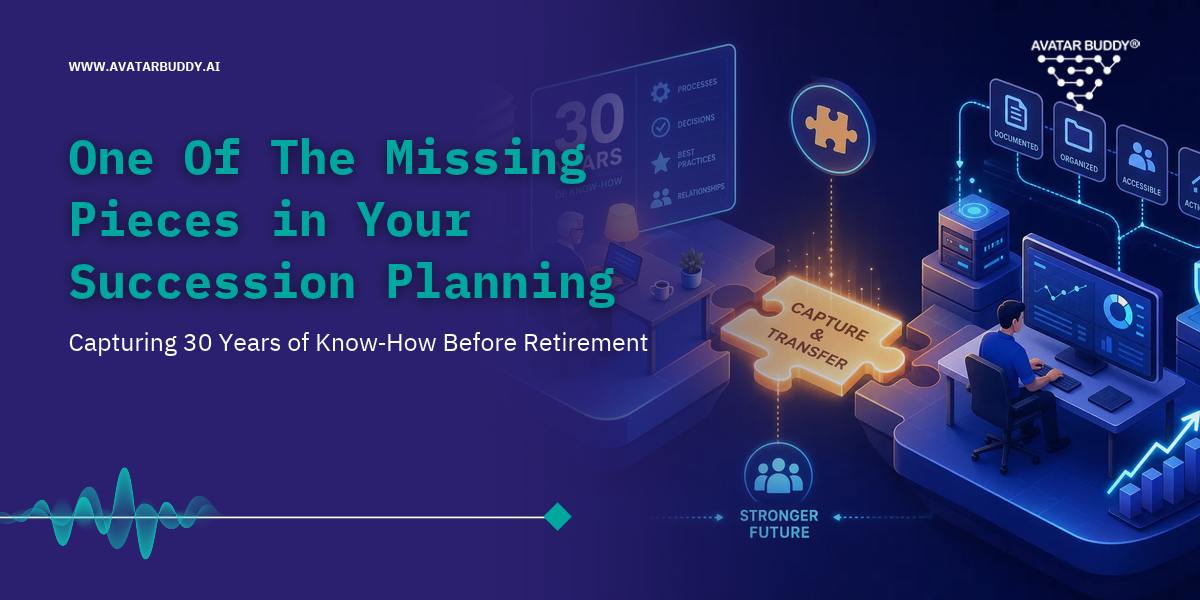
Most succession plans aren’t built for that moment. They answer one question well: who takes the seat. What they often leave out is the judgment, relationships and memory that live in one person’s head. It’s one of the missing pieces of succession planning, and it can quietly unwind years of progress.
What Most Succession Plannings are missing
Standard succession planning lives on the org chart. It:
- Lists key roles
- Names possible successors
- Rates how ready each person is
- Sets up training and development
All of that matters, and it keeps things stable on paper. But it often assumes knowledge will simply transfer during a handoff. Most of the time, it doesn’t.
A new leader might understand the job in theory but still not know:
- Which clients need a phone call, not an email
- Which vendors trust the person more than the contract
- Which quiet tensions are being managed behind the scenes
- Why a past change failed, and what people still remember about it
That unwritten knowledge is what makes a handoff feel smooth instead of shaky. When it walks out the door with Guillermo, even strong successors can spend months or years rebuilding context that once lived inside the company.
Finding Your “Guillermo” Roles
Before you can protect your business from knowledge loss, you need to see where the risk really sits.
Not every role is high risk. The ones that matter most often:
- Concentrate big decisions
- Hold key relationships mostly in conversation, not in writing
- Carry deep technical or regulatory expertise
- Would be hard to replace quickly from outside
In many organizations, this includes:
- The CEO or founder
- The head of HR or talent
- Senior instructors or trainers
- Any leader whose absence would stop a core process
A simple first step is a one‑page profile for each “Guillermo role.” Capture four things:
- What would break if this person left tomorrow
- How long it would take to steady operations
- Who could cover them in an emergency
- What they know that no one else fully knows
The goal isn’t a perfect document. The value is the honest conversation it forces, because you see where your company is more fragile than it looks on paper.
Turning What People Know Into Something That Sticks
Writing a process manual isn’t enough. A manual tells someone what to do. Institutional knowledge explains why it works, what to watch for, and how to handle the messy, real‑world cases that don’t fit the script.
The most valuable knowledge in your business is built on judgment. It lives in how a senior person:
- Reads a room
- Chooses a tone with a client
- Decides when to move fast and when to slow down
You won’t capture that by saying, “Write down your job.” You need structured conversations. For example, you can:
- Ask Guillermo to walk step by step through a hard situation he handled. What did he notice? What options did he see? Why did he choose one path?
- Give him a real‑world scenario and ask him to think out loud about what he’d do and why.
These simple methods reveal the thinking behind decisions, not just the final answer.
Making Knowledge Usable: Data Vaults, AI Agents and Digital Twins
Once you start pulling knowledge out of people’s heads, you need a safe way to store and use it.
At Avatar Buddy®, that foundation is called a Data Vault. It’s a private, secure place built only from your company’s own materials, holding:
- Process and policy documents
- Client and vendor history
- Notes from judgment‑based interviews
- Records of past decisions and outcomes
The Data Vault is encrypted and kept separate from public AI tools. It holds your history, your language and your way of working.
On top of this, Avatar Buddy® builds AI Agents and, for key leaders, Digital Twins.
- An AI Agent is a role‑specific helper, like a CEO Buddy, HR Buddy or Training Buddy. It answers questions based on your own data and patterns.
- A Digital Twin is an always‑available view of a specific leader’s documented knowledge and style. It doesn’t replace the successor. It gives them a bridge into the thinking that came before.
When a new leader steps in, they don’t have to guess. They can ask the Buddy how similar issues were handled in the past and what risks to watch for.
Letting Your “Guillermo” Actually Retire
There’s a part of succession planning nobody talks about: what happens to the retiree.
Without a plan, Guillermo’s phone keeps ringing. A “quick question” in week one becomes a standing call in month three. He’s technically retired, but the business still runs through him. That isn’t fair to him, and it isn’t a real succession plan.
With his knowledge in the Data Vault and AI Agents trained on how he works, the questions go to the Buddy instead of to Guillermo. The team gets the answer, along with the reasoning behind it, and Guillermo gets to enjoy the retirement he earned.
That’s what we mean by “Eliminate bottlenecks. Not people.” The business keeps moving, and the person who built so much of it can finally step away.
A Managed Path, Without Building an AI Team
Most small and mid‑sized businesses can’t hire full AI teams or run big custom projects on their own.
Avatar Buddy® offers a managed path instead. The AI Advisory team helps you:
- Spot your highest knowledge‑risk roles
- Build and maintain your Data Vault
- Design and update your AI Buddies and Digital Twins over time
Succession planning and knowledge continuity become a living part of how you run the business, not a one‑time document that grows stale.
Ready to fill in one the missing pieces in your succession planning? Book an AI Opportunity Mapping session with our team.